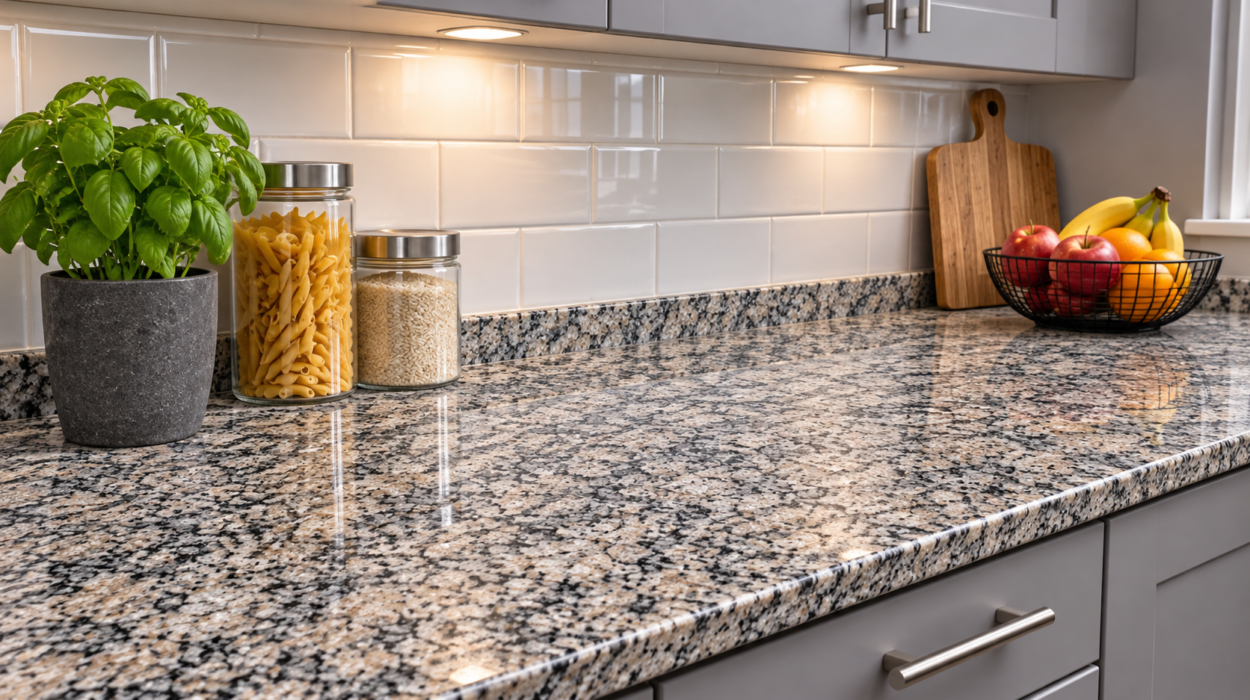
Choose quartz when an engineered surface and its care requirements fit your priorities. Choose granite when the character of a particular natural stone slab is central to the design. Both decisions should include a review of maintenance, heat exposure, fabrication details and the complete installed price.
There is no reliable rule that one category always costs less or suits every kitchen better. A specific quartz collection and a specific granite slab can produce very different quotes once the layout, edge treatment and installation are included.
Understand the materials before comparing them
Engineered quartz countertops are manufactured surfaces made with quartz and binding materials. Granite countertops are cut from natural stone slabs. Quartz should also be distinguished from quartzite, which is a different natural stone material.
A manufactured design can provide a more controlled visual range, but samples still do not show every detail of a finished installation. Granite’s pattern varies between slabs. In both cases, review enough material to understand what will appear on the island, long runs and prominent corners.
| Decision factor | Engineered quartz | Granite |
|---|---|---|
| Visual character | Manufactured designs with product-specific variation | Natural variation in each slab |
| Sealing | Many products do not require sealing | Need depends on the stone and treatment |
| Heat care | Follow manufacturer protection requirements | Protect from damaging heat and temperature changes |
| Selection method | Review the design at useful scale | Review and approve the actual slabs |
| Seam planning | Coordinate design direction and layout | Coordinate natural pattern and layout |
| Price comparison | Quote the exact product and fabrication | Quote the exact slabs and fabrication |
The table helps organize questions. It does not replace the care sheet for the chosen material or the fabricator’s assessment.
Look beyond a small sample
A small square is useful for checking color beside a cabinet door. It is less useful for predicting the effect of a large vein pattern across an island. Ask to see a slab image or full-size view and discuss how the design will be positioned.
With granite, approve the actual slabs where possible. Clarify which areas will be used and which visible natural characteristics are part of the selected material. With quartz, ask about pattern direction, batch variation and how seams will look in the proposed arrangement.
A practical exercise is to stand at the kitchen entrance and identify the surface you will see first. If the island is the main feature, spend time reviewing that layout. A small difference in pattern placement can matter more there than on a short run partly hidden by appliances.
Set realistic maintenance expectations
Cambria’s quartz care guidance states that its surfaces do not need sealing and recommends suitable cleaning and protection from heat. Those are product-specific instructions, not permission to use any cleaner or place any hot appliance directly on every quartz countertop.
For granite, avoid the automatic assumption that all slabs need resealing every year. The Natural Stone Institute’s guidance on sealing explains that sealing needs and benefits vary. Ask the fabricator what applies to the selected stone and any treatment already present.
Request a written care sheet that identifies approved products and maintenance decisions. A simple routine you understand is more useful than a promise that a surface is completely maintenance-free.
Plan around heat and everyday work
Locate the coffee maker, air fryer and other appliances before finalizing the kitchen arrangement. Read both appliance and countertop requirements for heat protection and placement. Use suitable trivets and cutting boards rather than relying on a broad claim that a material is durable.
The Natural Stone Institute’s care resources provide a starting point for natural stone maintenance. For any surface, the exact finish and product instructions should guide cleaning. A cleaner approved for one countertop should not be assumed appropriate for another.
Think about how the kitchen is used. A household that bakes frequently may want a generous clear work area. Someone who cooks with several countertop appliances may prioritize their placement and protected landing space. These layout choices can be more consequential than small differences in material appearance.
Coordinate the countertop with cabinets and fixtures
The countertop is part of a supported assembly. Confirm that the cabinets, overhangs and any special features are addressed in the fabrication and installation plan. Do not choose a support detail solely from an inspiration photograph.
This is a useful discussion to have with the countertop specialists at Intra Flooring, a Kent, Washington, retailer whose catalog includes quartz and granite. Reviewing the countertop alongside cabinet and flooring choices helps connect the material decision to the whole kitchen.
Before final measurement and fabrication, agree on:
- The selected sink and its installation details.
- Faucet and accessory holes, including their positions.
- Cooktop specifications and required cutouts.
- Edge profile and finished thickness appearance.
- Proposed seams and the direction of any strong pattern.
- Overhangs, support responsibilities and access for installation.
- Backsplash height and connections to adjacent surfaces.
Changes after fabrication can be difficult or costly. Resolve these details in the approved plan instead of treating them as small decisions to make on installation day.
Compare installed quotes fairly
Ask each supplier to price the same layout and scope. Check whether the quote includes templating, fabrication, delivery, removal of the old countertop, installation and the relevant cutouts. Identify who handles plumbing disconnection and reconnection.
Separate a material upgrade from a design change. A waterfall end, a complex edge or additional seams can alter the project independently of choosing quartz or granite. That distinction makes budget decisions clearer.
If you are comparing two options, list the reasons for preferring each in plain language. “I like this slab’s natural pattern” and “I prefer this product’s care instructions” are useful priorities. “This one is always better” is not specific enough to guide a real purchase.
Frequently asked questions
Does every granite countertop need annual sealing?
No. Sealing depends on the stone, existing treatment and conditions of use. Follow guidance for the selected slab instead of applying a universal annual schedule.
Can hot pans go directly on quartz?
Use the protection required by the manufacturer. Quartz should not be treated as heat-proof, and countertop appliances can also create sustained heat exposure.
Is quartz the same as quartzite?
No. Engineered quartz is a manufactured countertop material. Quartzite is a natural stone. Ask for the correct material identification and matching care instructions.
Which material is less expensive?
Neither is always cheaper. Compare the exact product or slabs with the same fabrication, installation and removal scope.
Conclusion
Choose between quartz and granite by comparing actual materials, care requirements and a complete installation plan. Review large-scale appearance, approve seams and fixtures, and understand the quote. Intra Flooring’s countertop offering provides a practical starting point for a kitchen decision based on how the surface will look and be used every day.