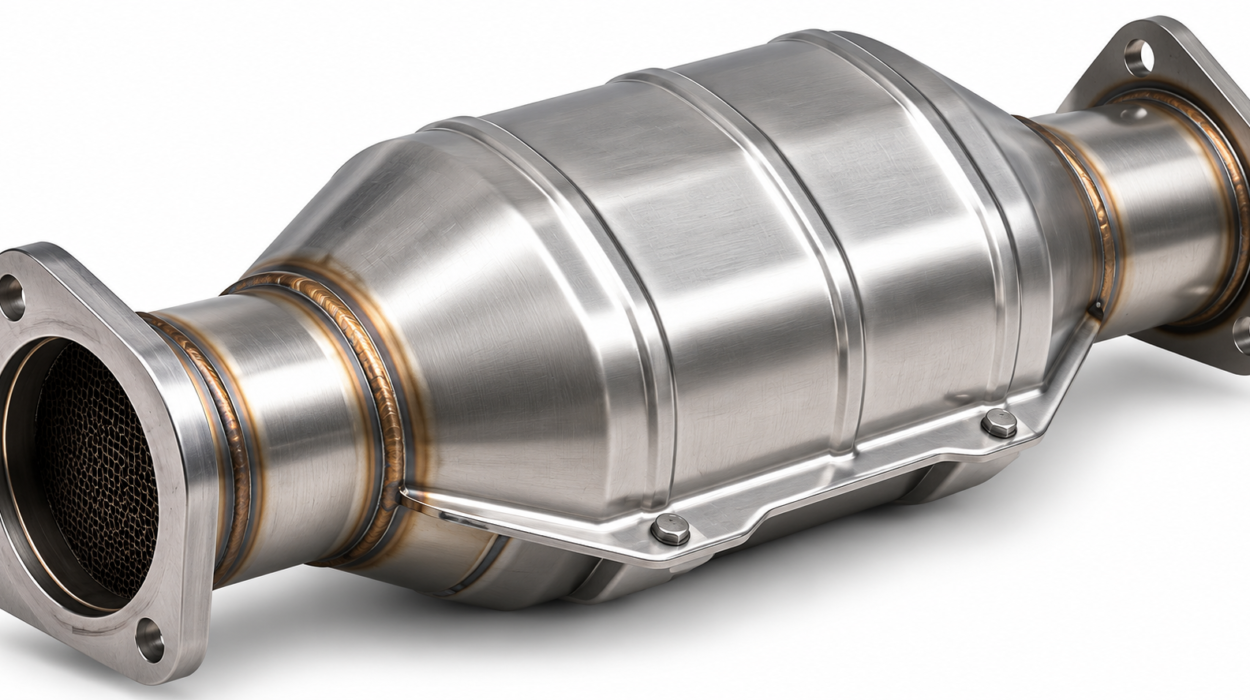
A catalytic converter warning can leave a vehicle owner facing an uncomfortable question: should you try a low-cost cleaning product, pay for further diagnostics, or replace the converter? Bottled cleaners are widely available and can be useful in the right circumstances, but they are not capable of repairing every fault that triggers an emissions warning.
Understanding the difference between contamination, an underlying engine problem, and physical converter damage can prevent wasted money. It can also help you make a more informed decision about repairing the vehicle and responsibly recycling the old unit if replacement becomes necessary.
What Does a Catalytic Converter Actually Do?
A catalytic converter is part of a vehicle’s exhaust and emissions-control system. Its internal ceramic or metallic substrate is coated with precious metals, typically including platinum, palladium, and rhodium. These metals support chemical reactions that transform harmful exhaust gases into less harmful substances.
The converter operates most effectively at a high temperature and depends on the engine delivering the correct air-to-fuel mixture. When combustion problems allow excessive fuel, oil, or coolant into the exhaust, deposits may accumulate inside the unit. More severe faults can overheat, poison, crack, or melt its internal structure.
This distinction matters because cleaning may help with limited surface contamination, whereas no liquid additive can rebuild a damaged substrate or restore precious-metal coatings that have deteriorated.
What a Cleaner May Be Able to Do
A reputable catalytic converter cleaner is generally added to the fuel tank according to the manufacturer’s directions. Rather than physically scrubbing the converter, the formulation is designed to help reduce certain deposits throughout the fuel and exhaust path when the vehicle reaches normal operating temperature.
Under appropriate conditions, a cleaner may offer several practical benefits:
- Reducing light carbon deposits: Minor contamination caused by repeated short journeys or extended low-speed use may be reduced after the engine reaches full temperature.
- Supporting more efficient combustion: Some formulations also clean parts of the fuel system, potentially addressing deposits that contribute to inefficient burning.
- Helping a lightly contaminated converter operate better: If the catalyst is structurally sound and the original engine fault has been corrected, removing limited residue may improve performance.
- Providing a relatively inexpensive first step: For a driveable vehicle with no serious symptoms, a correctly used cleaner may be worth considering before invasive work, subject to professional diagnostic advice.
Results are not guaranteed. A warning light may disappear temporarily because driving conditions changed, not because the root cause was repaired. Clearing a diagnostic code without investigating why it appeared can allow a small engine problem to become a costly converter failure.
What a Cleaner Cannot Repair
A Melted or Cracked Substrate
Severe overheating can melt the converter’s honeycomb channels, while impact, vibration, or thermal shock can crack the substrate. Symptoms may include rattling, restricted acceleration, excessive exhaust heat, or loss of power. A fuel additive cannot reshape or reconnect this physical structure.
Precious-Metal Depletion or Chemical Poisoning
Converter efficiency depends on active precious-metal surfaces. Contaminants such as phosphorus, silicone, lead, oil ash, or coolant residue may coat or chemically damage those surfaces. Cleaning products cannot reliably restore catalyst material that has been poisoned, depleted, or permanently degraded.
A Severely Blocked Converter
A badly restricted converter can create excessive exhaust back pressure, compromising performance and potentially causing additional engine damage. Continuing to drive may be unsafe. This problem requires professional testing and will often require replacement rather than a bottle of cleaner.
Upstream Mechanical and Electronic Faults
An emissions code does not prove that the converter itself is the original problem. Misfires, leaking injectors, worn spark plugs, failed oxygen sensors, air leaks, low compression, and oil or coolant consumption can all contribute to poor catalyst efficiency. A cleaner will not repair these faults. Worse, fitting a new converter before resolving them can quickly damage the replacement.
How to Diagnose the Problem Properly
Begin with an onboard diagnostic scan, but treat the resulting code as a clue rather than a complete diagnosis. A catalyst-efficiency code, such as P0420 or P0430, tells you that the engine control system has detected an efficiency issue. It does not automatically identify the converter as the only failed component.
A sound diagnostic process may include:
- Reading stored and pending fault codes as well as freeze-frame data.
- Checking for misfires, abnormal fuel trims, and air-to-fuel mixture problems.
- Inspecting the exhaust for leaks that could distort oxygen-sensor readings.
- Reviewing upstream and downstream oxygen-sensor activity.
- Testing exhaust back pressure or converter temperature where appropriate.
- Investigating oil burning, coolant loss, or fuel-system defects.
If the vehicle has only been used for short trips and testing reveals no mechanical damage, a cleaner followed by an appropriate drive cycle may be a reasonable option. Always follow the product instructions and applicable road rules. If the warning light flashes, the engine misfires heavily, the exhaust glows, or performance drops sharply, stop treating the issue as routine contamination and seek professional assistance.
When Replacement Becomes the Sensible Choice
Replacement is usually required when the substrate has collapsed, the unit is severely restricted, or testing confirms that catalyst efficiency cannot be recovered. The correct part must suit the vehicle and meet applicable emissions requirements. Quality matters: an unsuitable or poorly manufactured replacement can cause recurring warning lights and may not deliver the required durability.
Before approving the work, ask the repairer to explain the test results and confirm that the cause of failure has been addressed. This protects the new component and gives you a clearer basis for comparing parts and labour.
Why the Old Converter Still Has Value
A failed converter is not ordinary rubbish. Even when it no longer controls emissions effectively, it may retain recoverable platinum-group metals. Its value can vary considerably according to the part number, converter type, precious-metal content, condition, and current commodity markets. That is why an accurate catalytic converter price should be based on identification and material value rather than appearance or weight alone.
Blancomet works with individuals, garages, dismantlers, and larger suppliers to recover value from end-of-life catalytic converters. Its recycling process can include identification, decanning, milling, homogenisation, sampling, and laboratory-based analysis, depending on the material and commercial arrangement. Transparent assessment, compliant documentation, and responsible recovery help return valuable metals to productive use while reducing reliance on primary extraction.
If replacement is unavoidable, ask to retain the removed converter where lawful, confirm ownership with the garage, and obtain a quote from a specialist recycler instead of allowing a valuable secondary raw material to enter a general waste stream. Keeping the part number visible and avoiding unnecessary damage can also support accurate identification.
Make the Decision Based on Evidence
Cleaner is best understood as a limited maintenance or deposit-management product, not a liquid replacement for professional repair. It may help a structurally sound converter affected by light contamination, particularly after the underlying cause has been corrected. It cannot mend a cracked honeycomb, reverse melting, restore lost catalyst material, or solve an engine fault.
The practical sequence is straightforward: diagnose first, correct upstream problems, use a cleaner only when the evidence supports it, and replace the converter when physical or irreversible chemical damage is confirmed. When an old unit reaches the end of its service life, choosing an experienced recycler such as Blancomet can turn a repair expense into an opportunity to recover residual value and keep critical materials in circulation.